From the middle, everything is visible

“It is less about moving products and more about creating confidence.”
We sat down with Philippe Jarre, President of Mindware, to talk about what it means to sit in the middle of the chain in today’s world.
Q1: You sit in the middle of the chain. What does that feel like from where you stand, and how do you hold the chain together when it’s pulling in every direction?
Our position is unique because we have visibility that neither side has. Vendors see global production and strategy. Customers see their own projects and budgets. We see the entire ecosystem. During periods of disruption – whether supply shortages, geopolitical tensions, currency volatility or sudden shifts in demand – every participant naturally tries to optimize for themselves. Vendors want forecast accuracy, partners want flexibility, customers want immediate availability.
Our role is not simply to move products, it is to absorb volatility
That means providing transparency instead of surprises, investing in inventory when others hesitate, financing partners when liquidity becomes constrained, and constantly sharing market intelligence in both directions. The trust we have built over many years allows us to have difficult conversations early. Sometimes we tell vendors what they don’t want to hear. Sometimes we tell partners to slow down rather than over-invest.
Our objective is never to maximize one transaction. It is to preserve the health of the entire ecosystem because if one link breaks, everyone ultimately loses
Q2: Africa and the ME/Gulf are both growing fast – what do these two regions teach each other?
The Gulf teaches you the power of speed. Governments make decisions quickly, digital transformation is ambitious, AI investments are accelerating, and customers expect immediate execution. Africa teaches you resilience. Markets can be incredibly dynamic, infrastructure varies significantly, currencies fluctuate and every country requires a different operating model. Success comes from adaptability rather than standardization. Managing both regions forces you to avoid simplistic leadership. You cannot apply one playbook everywhere. What both regions share is entrepreneurial energy. Innovation often happens because constraints force creativity. Leading across both has taught me that resilience is not about resisting change – it is about building organizations that learn faster when the environment changes around them.
Q3: At what point did you stop trying to plan around turbulence and start building a business that runs inside it?
Probably during the 2008 crisis when I was working for IBM. Like many companies, I initially viewed disruption as temporary. I kept expecting markets to normalize. Eventually I realized something important: Normalization was no longer a strategy. Instead of asking, “When will things become stable again?” I started asking, “How do we become successful even if instability continues?” That fundamentally changed my business approach and I then tried to apply it at Mindware during Covid. We diversified vendors and technologies, strengthened our services capabilities, invested more heavily in cloud, AI and cybersecurity, improved forecasting with data analytics, and built much greater financial flexibility. As a leader, I also changed. I became less focused on having perfect answers and more focused on helping the organization make faster decisions with imperfect information.
Today, agility is a competitive advantage in itself
Q4: In difficult environments, trust is tested – how do you maintain alignment?
People don’t expect leaders to eliminate uncertainty. They expect leaders to eliminate confusion. That means communicating far more frequently during difficult periods than during stable ones. Internally, we share what we know, what we don’t know and what actions we are taking. Transparency creates confidence. We also decentralize decision-making. Markets move too quickly for every decision to come from headquarters. Externally, consistency is critical. Partners and vendors remember whether you stood by your commitments during difficult periods. Sometimes protecting long-term trust means accepting lower short-term profitability. Those decisions always pay back because trust becomes a strategic asset that competitors cannot easily replicate.
Q5: You’ve watched competitors make decisions under pressure – what separates those who emerge stronger?
Companies that emerge stronger don’t simply cut costs. They invest selectively while others retreat. During turbulent periods, many organizations reduce inventory, reduce talent, reduce innovation and become defensive. We took a different approach. We continued investing in strategic growth areas like AI infrastructure, cloud, cybersecurity and specialized technical capabilities because we believed those markets would accelerate once confidence returned.

The decision I’m most proud of was continuing to invest in people
Talented employees are difficult to replace, and culture becomes even more valuable during uncertainty. When markets recovered, we were ready to grow immediately because our capabilities had actually become stronger while others were rebuilding.
Q6: If turbulence is the new normal, how does the distribution model need to evolve?
Distribution is evolving from logistics to intelligence. Twenty years ago, value came from moving products efficiently. Today, products are increasingly available everywhere. The real value comes from helping vendors and partners navigate complexity.
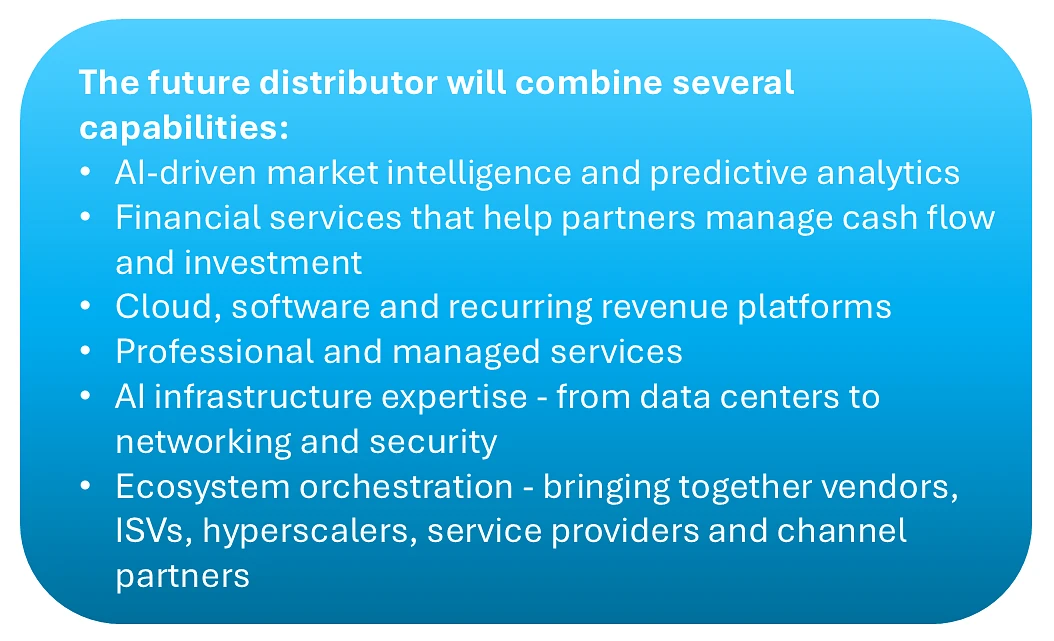
Ultimately, distribution becomes the platform that accelerates innovation across the ecosystem. The companies that succeed won’t be the ones with the biggest warehouses. They’ll be the ones with the strongest data, the deepest expertise, the best financial capabilities and, above all, the highest level of trust. For many years, distributors were measured by how efficiently they moved boxes. Today, we are measured by how effectively we move ecosystems. In a world where technology changes every month and geopolitical uncertainty is constant, our role is no longer to reduce friction in the supply chain – it is to create confidence. Confidence for vendors, confidence for partners, and confidence for customers. That’s what modern distribution is really about.